4 November 2026: Multilingual methodologies endorsed by new research
Newly commissioned research from the University of Oxford shows WoLLoW's innovative approach, which positions 'language itself as an object of inquiry', makes it 'a language-awareness and plurilingual curriculum that responds to several current concerns in primary language education'. Read on to find out more.
By John Claughton, Co-Founder, ‘WoLLoW’, World of Languages, Languages of the World
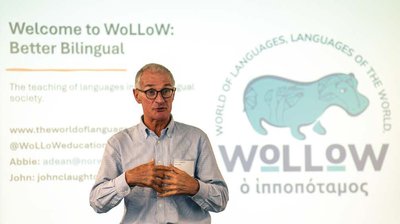
‘WoLLoW’, World of Languages, Languages of the World, is a free multilingual languages course which offers 150+ lessons for pupils aged between 7 and 13. It was devised by very experienced teachers, and it can be taught by anyone. It addresses issues fundamental to the success of language provision in two ways. The first is that replaces the teaching of a specific language with an approach which encourages curiosity, shared exploration, problem-solving, dialogue, even fun. Thereby it acts as a preparation for the teaching of specific languages at a later stage. The second is that it encourages pupils to think about and share their own linguistic and cultural histories, encouraging a sense of identity and belonging in pupils and mutual understanding between pupils. After all, it may be over a decade since primary languages became a compulsory part of the National Curriculum, but it is over 50 years since Lord Bullock wrote ‘No pupil should be expected to leave his/her own language at the school gate’. Sadly, that’s exactly what we have been doing for half a century.
Over time, this approach could encourage more pupils to study more languages in later years, not just the languages of the European canon but the languages of their families and communities. All the feedback we have received from teachers tells us that WoLLoW works in many different educational contexts. However, we know that, in this world of evidence-based decision-making, this isn’t enough. So, with the support of HMC and the Department of Education at the University of Oxford, we commissioned Xiaoying Wu, a graduate working on her own doctorate, to research the relationship between WoLLoW’s methodology and the existing research on the teaching of languages.
Perhaps the most striking revelation for those of us who created WoLLoW as teachers, rather than academics, is that we are the heirs to a movement and a debate which goes back to the were re-opening a movement and debate that goes back to the 1980s. At that time, there was a strong drive in this country, led by Eric Hawkins. towards a ‘language awareness’ approach to language learning. The fundamental principle was that this approach served as an apprenticeship, a preparation for studying languages in the future. This approach has remained strong in other European countries but in England it did not survive in the strict regime of the National Curriculum.
However, Xiaoying’s research does show that WoLLoW’s approach is closely aligned with substantive academic research and has the capacity to have a positive impact on the attitude of pupils’ attitude to language learning:
‘WoLLoW offers a distinctive curriculum that introduces pupils to language families, scripts, etymology, grammar, multilingualism, home languages, and intercultural understanding, encouraging them to explore language as a historical, cultural, and social phenomenon rather than solely as a vehicle for communication. By positioning language itself as an object of enquiry, the programme raises broader questions about the purposes of primary language education and how language learning can respond to the multilingual realities of contemporary schools.’
However, the research also suggests that WoLLoW is more than an alternative to – or companion of - a traditional language curriculum. It goes beyond that. First, it brings multilingualism into the very heart of the languages curriculum, encouraging inclusion and bringing EAL pupils to the centre:
‘WoLLoW has the potential to position multilingualism as part of mainstream primary education rather than as a concern associated only with particular groups of learners. This may represent one of WoLLoW's most significant contributions to contemporary multilingual education research.’
And, second, it can have a much broader impact on pupils’ sense of self and their understanding of each other and of the increasingly diverse communities in which they live.
‘WoLLoW is most appropriately understood as a language-awareness and plurilingual curriculum that responds to several current concerns in primary language education: the need to value pupils’ linguistic repertoires, develop curiosity about languages, support metalinguistic awareness, engage teachers and families, and connect language learning with identity, belonging, and social understanding.’
Few things could be more important than that in these times of dangerous and divisive rhetoric and politics.