
13 May 2026: A creative writing activity about... Creativity
A creative writing activity about... Creativity.
In the context of statutory requirements prescribing content in ITE ( In the balance: the artful mix that goes into becoming a Modern Foreign Language teacher | UCL IOE Blog ), Faris' opinion piece advocates for the role of creativity in language teacher education.
By Faris Sanhaji, languages teacher and Lecturer in Education, Goldsmiths University of London.
Taking the words of Ken Robinson literally (2011) when defining creativity (“Creativity is the process of having original ideas that have value”), I decided to plan the seminar directed at PGCE secondary students at Goldsmiths University on the same theme, but creatively. It did not require too much planning, mostly ideas of group activities and defining the steps of the creative process. It confirmed to me that the best lessons are often the ones that require little planning and where students are expected to be responsible for most of the work.
The session is thought to be a reflection on and a celebration of creativity. It can be led in any language, as long as the language for interactions is provided. The idea is to take students in the process of creative writing through modelling of the different steps into creativity:
- Setting an objective or a product
- Brainstorm ideas
- Make choices
- Plan a draft
- Create
- Present your creation
Steps
1. Present the product
To ignite their imagination, inspire and support them at the same time, the teacher asks the students what a calligram is. With guidance (and etymology: kallos meaning beauty and gramma meaning letters, writing in Greek) and a quick browsing on Internet makes them understand it is a form of concrete poetry. By showing examples of calligrams, the teacher ensures that the task is compelling as s/he intends to light a spark of creativity in them
2. Gather thoughts
In groups of 5 or 6, let groups discuss to assign roles for individual students:
The teacher starts by asking students to finish the sentence: “For me, creativity is…” in the form of a list. Students can use words or sentences, and each person needs to give at least three ideas. Once the ideas are shared in groups, the teacher asks for each reporter to share the ideas with the class and writes them on the board. Here, the objective is for inspiration to be shared across the groups. The teacher invites them to add ideas they find inspiring to their own list. At this stage, it is important to open the floor to the maximum number of ideas to foster divergent thinking.
3. Decide on an animal
The following activity is to look at the list in groups and discuss which animal could best represent several or most of the words or sentences listed. This is conducted in the form of a debate where students need to find a shared agreement on one animal. You might choose to ensure that the choice is kept secret to increase the momentum at the end of the session.
4. Prepare a draft
Once the animal is chosen, the student with good artistic skills will use a pencil to draw the form of the animal on a large poster. Meanwhile, the rest of the group plans the calligram, deciding which words to be the most salient and where to place them. Here again, it is good to give them choice and time to think about the representation. For instance, if their animal is the fox, in which parts would they write the words intelligence, adaptability or playful? In the head, paws or tail? And how big should the writing be? Drafting and planning is a key step in the creative process, the moment when abstract ideas are materialised on the support.
5. Write!
Students can now engage with their animal form on the poster, and everyone is asked to contribute to this shared writing activity. The teacher is there to circulate, encourage participation, suggest ideas to enhance the calligram and incidentally, remind students of the time. The teacher also encourages students to use several languages if they can, vary the punctuation and use symbols if they wish.
6. Present in groups
Each group is asked to turn their poster so that it is not visible. Each group comes to the front to reveal their calligram to the audience. This is generally an enjoyable moment, where students feel pride in achieving not only beautiful outcomes, but also get to explain the meaning behind it. Each member of the group has time to present an aspect of their calligram, explaining choices and the rest of the groups can ask questions or offer feedback. It is critical to consider that creative work needs to be presented and discussed to have authentic value.
Examples
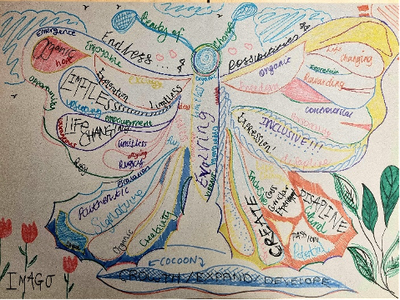
Creativity represented as a butterfly to symbolise freedom, change (notice the cocoon below) and endless possibilities:
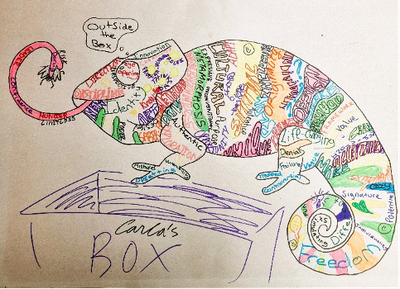
Creativity ‘outside the box’, diversity in the colours, eating the fly ‘risk’:
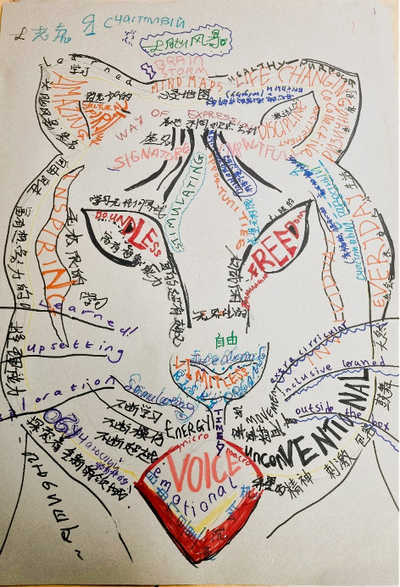
A multilingual creative tiger, free and untamed:
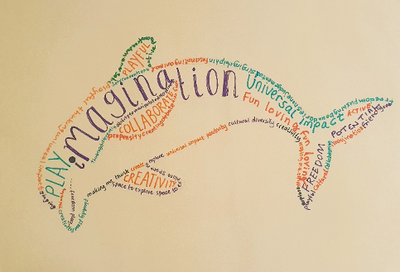
Creativity as a dolphin for its freedom of movement, playfulness and imagination (dot on the i symbolising the eye of the dolphin):
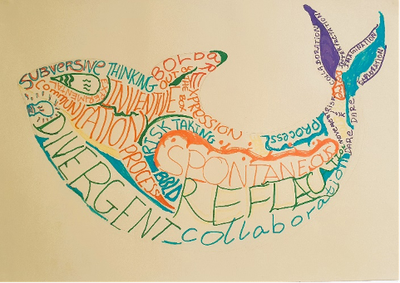
Creativity is a killer whale, emphasising collaboration in creativity:
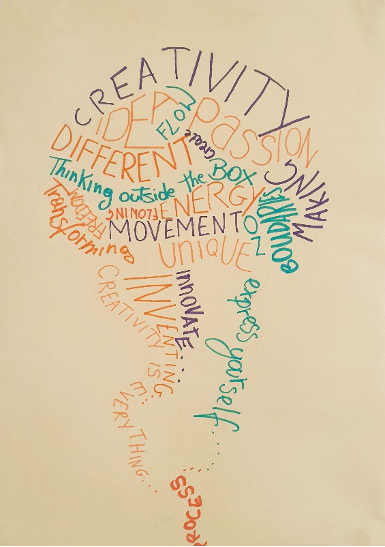
The creative jellyfish, with many tentacles to deploy its creativity:
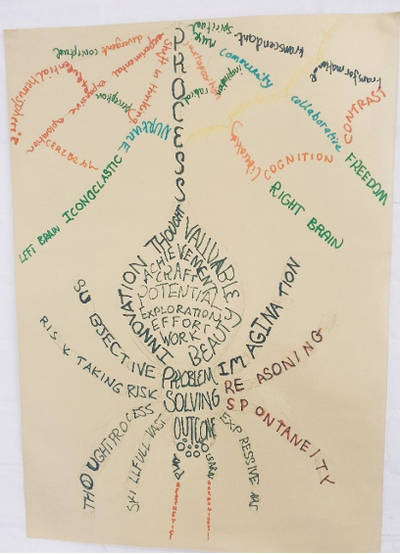
The creative spider, weaving its web to spread its creativity:
Material / Time
- A session of 90 minutes is ideal
- Markers and felt-tip pens
- A1 or A2 posters
References
Durham (2019) The Durham Commission on Creativity and Education. Durham University and Arts Council England.
Robinson, K. (2011). Out of Our Minds: Learning to Be Creative Chichester: Capstone.
Biography
Faris is a languages teacher and a Lecturer in Education. He teaches on the PGCE Secondary Modern Languages Programme at Goldsmiths, University of London, and is also involved with the PGCE Primary as well as Masters in Education programmes. Fluent in four languages, Faris has taught in France, Spain and in the UK. He has taught French and Spanish in several inner London schools, becoming Head of Spanish from KS2 to KS5 in an East London school. He further developed the vision and curriculum of his department using films, authentic texts and culture to enhance communication. He has a great interest in language pedagogy, research on second language acquisition and heritage languages.
The pictures were taken by Faris, with the authorisation of the students to reproduce their work.