
1 October 2025. Returning to the ‘Languages Crisis’
Returning to the ‘Languages Crisis’
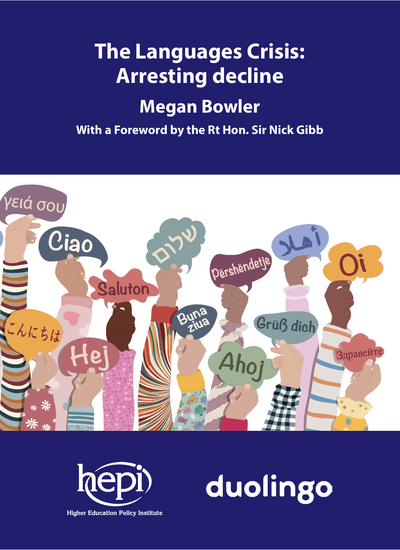
Megan Bowler, author of HEPI's new report The Languages Crisis: Arresting decline published this summer, reflects on what has changed since she first authored a report on this subject for HEPI five years ago.
By Megan Bowler, DPhil student in Classics at the University of Oxford and Lecturer in Ancient Greek Language and Literature at Oriel College and the Faculty of Classics.
5 years ago, as an undergraduate intern, I wrote a report for the Higher Education Policy Institute (‘A Languages Crisis?’), and in 2025, HEPI’s Director Nick Hillman suggested that it was time for another piece to provide an update. Though I am now rather busy with doctoral research, I jumped at the chance to return to languages policy! I had already been reflecting on this topic again at the end of 2024, when I read the news that the Latin Excellence Programme (modelled on the Mandarin Excellence Programme) had been scrapped. As a classicist, it was disappointing to hear that a project which sought to improve access to Latin was no longer a priority. This seemed to represent a bigger picture across both ancient and modern languages: the perception of languages as ‘elitist’ is at risk of becoming a self-fulfilling prophecy, and I was keen that Classics and MFL should be working together to combat this.
What has happened since 2020?
For this second report, I wanted to focus on developments since 2020 – I had intended to write a brief policy note, but I found that there was plenty to say, and a lot of new research to highlight. While news stories continued to emphasise the low participation in language-learning (notably the decline of French and German in schools), I was conscious of responses along the lines of: ‘So what? The rest of the world speaks English!’, and ‘ChatGPT can translate for us!’. I wanted to make the case specifically for why language-learning is more relevant, not less relevant, in the age of AI.
I drew on my experience of learning languages and teaching ancient Greek to identify 13 reasons why a ‘linguistic mindset’ equips us for this age of technological change. These include close and critical analysis, cultural adaptability, creative problem-solving, precision and clarity of expression, and empathy towards new perspectives. The ‘linguistic mindset’, an expression I liked when reading about the Queen’s College Translation Exchange project, appealed to me for a number of reasons. Firstly, you can access these benefits from engaging and participating, not just from reaching perfect fluency in one language (a point articulated well in John Worne’s piece: ‘Time to Embrace Our Imperfection?’). It also celebrates the value and transferability of all kinds of language-learning: ancient and modern, students’ existing multilingualism, signed languages, and the UK’s own linguistic heritage (e.g. Welsh and Gaelic).
New challenges
But it’s clear that we need not only a new public idea about languages, but investment and intervention. Revisiting the issue 5 years on and speaking with colleagues and teachers, I was struck by how difficult teacher recruitment has now become. This is further harming languages in schools, as well as worsening disparities between independent and state schools. While I was writing, Cardiff University was planning to cut its modern languages and translation programmes: Cardiff being the largest provider of MFL degrees in Wales, and responsible for a brilliant mentoring scheme across 80% of secondary schools. While the full devastation was averted, we can in no way be complacent: the position of these subjects is far from secure, and we should be troubled too by the closures that have now affected the majority of post-1992 institutions. This made it clear to me that it’s not enough simply to ask HEIs not to close programmes and departments that are struggling with demand – we need national oversight to protect high-level linguistic expertise, particularly for strategically important subjects, and investment to co-ordinate and sustain the outreach and mentoring schemes our sector contributes.
Pressures on participation in schools and universities
Another focus of my research was to compile data on participation in languages in schools and HE, from the JCQ and HESA. The graphs present a rather bleak picture of the low participation in languages, especially relative to other subjects; insights from the Languages Trends surveys shed further light on the fact that our ‘languages crisis’ is characterised especially by unequal opportunity. I still maintain that additional qualification pathways or recognition frameworks would facilitate participation beyond these qualifications: for instance, those suited to heritage learners, and the British Academy’s suggestion of a post-16 vocational certificate. Turning to the pressures facing languages degree programmes in HE and institution-wide language provision, the UCFL, AULC and CUCD’s reports provided useful insights; keeping track of how languages departments and centres are faring in HE is important. Once again, and particularly after conversations I had with policymakers in other countries, I recognised that being able to share statistics is paramount for gaining traction. Finding ways of collecting and sharing more quantitative evidence (about the state of languages in HE, the insights of teachers, the perceptions and motivations of students, the success of outreach initiatives, and the benefits of language study) really matters.
Urgency, not hopelessness
Previously in A Languages Crisis?, I suggested that the issues we face are long-term and systemic, rather than a sudden ‘crisis’. Nonetheless, the ‘crisis’ label has stuck, and we might think of its ancient Greek origins as a decisive moment or turning point. It is a reminder of urgency, but not hopelessness. Let us hope, then, that the momentum we are seeing for languages at the moment – and indeed the Languages Gateway, which will provide a useful point of coordination and for making connections between policy and practice – will keep a spotlight on languages and help us to generate change for the better.
The Higher Education Policy Institute’s new report, The Languages Crisis: Arresting decline by Megan Bowler (HEPI Report 192) is available here.
References
Bowler, M. (2020). A languages crisis? London: HEPI.
Worne, J. (2025). ‘The UK's Languages Crisis: Time to Embrace Our Imperfection?’ Languages, Society & Policy. Faculty of Modern & Medieval Languages and Linguistics, University of Cambridge.